The primary differences between men’s and women’s equestrian competition jackets lie in structural tailoring and the mapping of compressive textiles. Women’s jackets utilize aggressive princess seams, side darting, and a shorter overall hem length tailored to sit perfectly above the peak of the saddle cantle, accommodating broader hip-to-waist ratios without bunching. Men’s jackets feature a broader, reinforced shoulder chassis, wider, traditional lapels, four-button closures (compared to the standard three for women), and a longer, squared vent system at the rear to drape seamlessly over a narrower pelvis. Both must adhere to strict, historical USEF and FEI stylistic guidelines while secretly integrating modern bi-elastic sportswear technologies.
1. Tailoring for the Modern Arena
Equestrianism remains one of the last Olympic sports where male and female athletes compete directly against each other on a perfectly level playing field. However, while the technical requirements of navigating a 1.60m Grand Prix course or executing a perfect Piaffe do not change based on gender, the biomechanical framing of the rider’s body demands highly distinct sartorial architectures.
The competition jacket (or "show coat") is not merely a costume; it is an athletic exoskeleton bound by centuries of strict European tradition. A poorly tailored coat will visually distort a rider's equitation to the judge, creating the illusion of a roached back or a swinging leg. Understanding the profound engineering differences between men's and women's coats is critical when selecting attire that flatters your specific anatomy while surviving the physical violence of competitive riding.
Comprehensive Table of Contents
2. The Structural Cut: Darts and Princess Seams
The most visually defining difference between the two garments is the approach to the waistline.
Women’s Jackets: The female anatomical frame typically presents a significantly wider hip-to-waist ratio. To ensure the coat remains flush against the lower back during the sitting trot—without aggressively pulling at the bust—women's jackets rely on "Princess Seams." These are long, continuous curved seams that run vertically from the armhole down to the hem. Furthermore, deep darts are taken at the lumbar region. This forces the heavy softshell fabric to elegantly taper inward at the natural waist before sharply flaring out over the hips, preventing the coat from creating a boxy, unflattering silhouette.
Men’s Jackets: The male frame generally requires a straighter, more cylindrical drop from the latissimus dorsi to the hips. Men's coats utilize shallower side seams and rely heavily on a traditional double-vented back. The waist suppression in a men's coat is subtle, designed to project a broad, inverted-triangle silhouette emphasizing shoulder width rather than waist narrowness.
3. Hem Length and Saddle Clearance
If a jacket is too long, the rider will invariably sit on the rear tails of the coat, pinning the fabric beneath their buttocks. This physically locks the coat against the saddle, restricting the rider from leaning forward over a jump without the jacket violently choking them at the collar.
Because women, on average, have a shorter torso length relative to their leg length compared to men, women's competition jackets feature an aggressively cropped hem. A perfectly tailored women's coat should terminate exactly 1 to 1.5 inches below the hip bone—just long enough to brush the top of the saddle cantle without falling beneath the rider's seat.
Conversely, men's coats are cut noticeably longer in the body. The traditional male hemline is engineered to drop cleanly past the hip joint, relying entirely on the twin rear vents (slits) to physically separate and drape over the back of the saddle when the rider sits.
4. Buttons, Lapels, and Formality
The micro-details of equestrian tailoring are heavily regulated by unwritten rules of tradition.
Closure Mechanics: Women's show jumping and hunter jackets almost universally feature a three-button front closure. The top button is positioned slightly lower on the sternum to accommodate varying bust sizes without gaping. Men's jackets traditionally feature a four-button stance. This higher, tighter buttoning visually elongates the male torso and creates a narrower "V" shape at the neckline, meant to prominently display the mandatory crisp white competition tie.
Lapel Width: Men's jackets feature significantly broader lapels, often utilizing heavier interlining to keep the lapel rigid and flat against the chest, even in heavy wind. Women's coats feature narrower, highly tapered lapels that gracefully curve with the natural line of the bust.
5. Mapping Bi-Elastic Fabrics by Gender
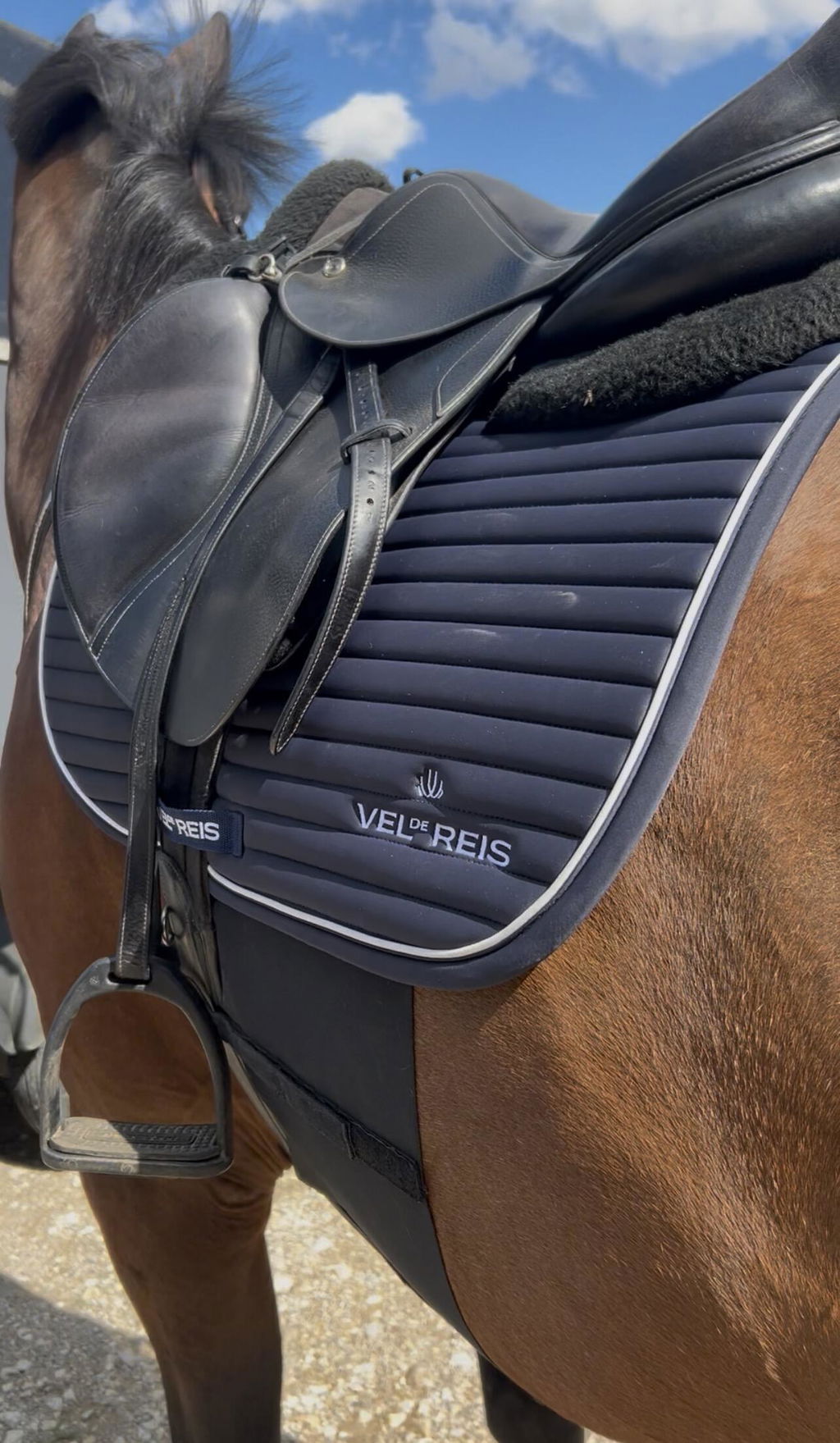
The hidden genius of modern Italian equestrian wear, such as the premium lines cultivated by Vel De Reis, lies in fabric mapping. Because men and women recruit muscle groups differently in the saddle, the elasticity of the jacket must be engineered to match.
Men typically carry more mass in the deltoids, trapezoids, and latissimus dorsi. Therefore, premium men's coats feature specialized "hidden gussets" or highly elastane-dense zones strictly across the upper scapula. This allows a male rider to explode into a two-point jumping position without the coat pulling tightly across his broad back and restricting his arm extension toward the horse's mouth.
Women's jackets prioritize 360-degree bi-elasticity firmly through the core and oblique zones. This ensures the jacket acts as a mild compressive exoskeleton, offering the rider continuous sensory feedback to engage their abdominal wall, which is critical for stabilizing the female pelvis in the dressage arena.
6. Comprehensive FAQ Guide
Can a woman wear a men’s competition jacket?
Generally, no. A men's jacket is completely devoid of the necessary bust darts and hip flares. If a woman attempts to wear a men's coat, the fabric will bunch severely across the shoulders, gap wildly at the collar, and the longer hem will become trapped under her seat in the saddle.
What colors are legal for show jackets?
Historically, only navy blue, black, and dark hunter green were permitted. However, modern USEF and FEI rules have relaxed significantly. Currently, subtle grays, burgundies, and muted earth tones are legal in show jumping, while dressage remains fiercely loyal to conservative navy and black tailcoats.
Why are competition jackets unlined?
Traditional wool coats were heavily fully lined with silk or heavy woven polyester. Modern softshell coats are intentionally unlined (or feature only a fractional mesh lining at the shoulder hierarchy). Removing the lining dramatically reduces the weight of the jacket, maximizes the four-way stretch of the softshell, and prevents heat from trapping against the rider's skin in the summer.